Your services, reputation, and ambitions have grown. Your website should help customers see that, and make the next step clear.
We redesign websites for established businesses that need clearer messaging, stronger customer journeys, and an experience that supports how people choose, contact, or buy from them today.
5.0 client rating · Selected redesign work: Apex Athletics
The pages load. The logo is right. The contact form exists. But customers still have to work too hard to understand the business or move forward.
Your business has grown, but the website still represents an earlier version of it.
A more modern design can strengthen credibility and create an experience that better reflects the quality of the business today.
Services, information, or important next steps may be buried behind confusing navigation or weak page hierarchy. A redesign can simplify the experience around what customers are actually trying to accomplish.
People reach the website, but aren’t consistently calling, requesting quotes, booking, purchasing, or completing the actions that matter.
The problem may be messaging, page structure, calls to action, user experience—or a combination of all four.
A website can technically be responsive without providing a good mobile experience.
Important information, navigation, forms, and calls to action should be intentionally designed around smaller screens.
Years of updates, plugins, page builders, inconsistent layouts, or technical debt can make simple website changes unnecessarily difficult.
Without reliable analytics and conversion tracking, it’s difficult to know which pages help customers move forward and where opportunities are being lost.
Apex Athletics had an existing website with weak user flows and limited opportunities for visitors to act.
We redesigned the navigation, messaging, visual experience, mobile UX, and calls to action around a more intentional customer journey.
Important information became easier to discover, and visitors were given clearer next steps at key decision points.
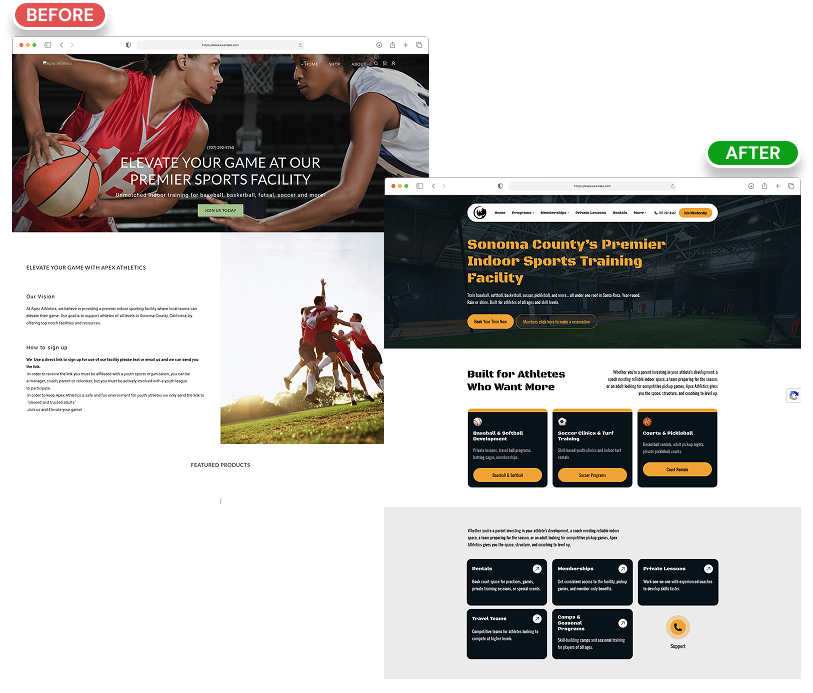
Result: 60% increase in engagement
Want to Improve What Your Website Is Doing for the Business?
Request a Strategy Call
When a website feels outdated or underperforms, redesigning it can seem like the obvious answer.
But changing colors, layouts, and typography won’t necessarily fix:
If you don’t know what’s creating the friction, you risk rebuilding the website without fixing the problem.
01
We discuss your customers, current website, and business priorities to identify what needs a closer look.
02
We shape the messaging, pages, design, and functionality around the actions customers need to take.
03
You gain a website that better represents the business, makes key actions easier, and has agreed measurement in place.

Your scope may include positioning and copy, navigation and page structure, customer proof, mobile usability, forms, booking or purchasing paths, performance, accessibility improvements, and analytics.
Existing content, valuable URLs, tracking, and integrations are evaluated before major changes are made. The goal is not to erase the current website; it is to keep what is useful and improve what is getting in the way.
The right scope may be priority-page improvements, a broader redesign, or a complete rebuild. We can work within WordPress or another suitable existing setup when it still meets the requirements.
When publishing and platform limitations are the larger issue, CMS & Website Modernization may be part of the engagement.
Those goals help guide decisions throughout strategy, UX, design, development, and launch.
We don't approach every website redesign with the assumption that it needs to use the same CMS or technology. Some websites should stay on WordPress. Others may benefit from Next.js, a headless architecture, or a more specialized implementation. The decision depends on things like:
If your existing platform is still a good fit, we can redesign within it rather than creating an unnecessary migration.
Website redesign is for businesses that already have a website they want to improve.
If you're launching a business and need your first professional website, our Business Website service is the better place to start.
EXPLORE BUSINESS WEBSITES

You don’t need to make that decision before contacting us.
We first look at what’s working, what’s creating problems, and what the business needs next.
Sometimes improving the existing website makes sense. Other times, the current structure or technology makes a larger rebuild the better long-term decision.
Yes.
If most of the website is working well, we can focus on priority pages, service sections, landing pages, navigation, conversion flows, or other parts of the experience that need the most improvement.
Yes.
We work with existing WordPress websites, including Elementor, Gutenberg, other established page builders, themes, custom functionality, APIs, and third-party integrations.
For more WordPress-specific development capabilities:
View WordPress Development Services
A poorly planned website migration can affect organic visibility.
For larger redesigns, we account for existing URLs, important content, redirects, metadata, internal links, and other technical SEO considerations before the new website goes live.
Yes.
Existing content can be preserved, reorganized, improved, consolidated, expanded, or rewritten depending on what the redesign requires.
The goal isn’t to replace content simply because it already exists. It’s to determine whether it still supports the customer and the business.
Yes.
Depending on the project, we can help structure, refine, and develop website content around your services, customers, search intent, and conversion goals.
Yes.
Analytics and conversion tracking can be planned into the redesign so important user actions can be measured after launch.
This can include GA4, Google Tag Manager, lead forms, phone clicks, purchases, booking actions, and other important events depending on the business.
Yes.
Depending on the project, we can work with CRMs, email platforms, booking tools, payment systems, analytics platforms, APIs, forms, and other business services.
Yes.
We frequently work with existing websites and do not require the original website to have been developed by Solorio Designs.
We first review the existing implementation to determine what’s practical to preserve or improve.
Timing depends on the size of the website, amount of content, functionality, integrations, feedback process, and whether we’re improving the existing implementation or completing a larger rebuild.
After discovery, we’ll define the project scope, deliverables, and expected timeline.
No.
You may simply know that the website feels outdated, isn’t generating enough business, has become difficult to maintain, or no longer represents the company accurately.
Identifying the underlying problems is part of the redesign process.
Not always. If the project is already well defined, strategy can be incorporated into the redesign engagement. When there are larger unknowns around UX, analytics, conversion paths, content, SEO, or technology, we may recommend starting with a standalone Website Diagnosis & Conversion Strategy before committing to implementation.
Yes. Based on our discovery conversations, we can prepare the initial copy direction and first draft around your services, customers, and conversion goals. You review and refine it for accuracy and brand voice before final approval. We can work with existing photography and video, or use appropriate stock imagery when original assets are limited.
Not necessarily. We recommend a platform change only when the current setup cannot reasonably support the agreed experience or becomes a material obstacle to maintaining it.
We agree on relevant measures before launch, such as completed inquiries, bookings, key customer actions, or usability improvements. Available baseline data and the measurement setup determine what comparisons are possible.
Tell us what your current website no longer communicates or supports.
We’ll use a 30-minute strategy call to discuss whether you need focused improvements, a strategic redesign, or a broader rebuild.
Strategy, UX, and development in one engagement