CMS & WEBSITE MODERNIZATION
Routine content changes should not require workarounds or development every time.
We help established organizations modernize the CMS, content structure, publishing workflows, and integrations behind their website—so the team can manage the experience with greater control and less unnecessary friction.
Request Your Strategy Call
Founder experience includes in-house CMS architecture and migration work at Graton Resort & Casino.
More services, content, campaigns, and contributors have been added. The platform still reflects how the organization worked before those changes.
Marketing waits for routine page changes because the available templates and tools do not support the work they need to do.
Rigid layouts, duplicated content, unclear permissions, and inconsistent previews make everyday publishing harder than it should be.
Plugins, custom code, and integrations have accumulated without a clear structure for maintaining them.
Important content, URLs, analytics, forms, and connected systems all need attention when the platform changes.
The new system needs to be designed around the people operating it and the experience it supports.
Marketing needed to build and update pages without relying on development for every change.
Working in-house, Jose helped restructure the CMS around reusable fields and components, migrate existing content while preserving SEO structure, and implement caching strategies based on content source and update frequency.
Reusable page building. Less developer dependency for routine changes. Content-aware performance planning.
This work was completed in Jose’s in-house role at Graton Resort & Casino, not as a Solorio Designs client engagement.
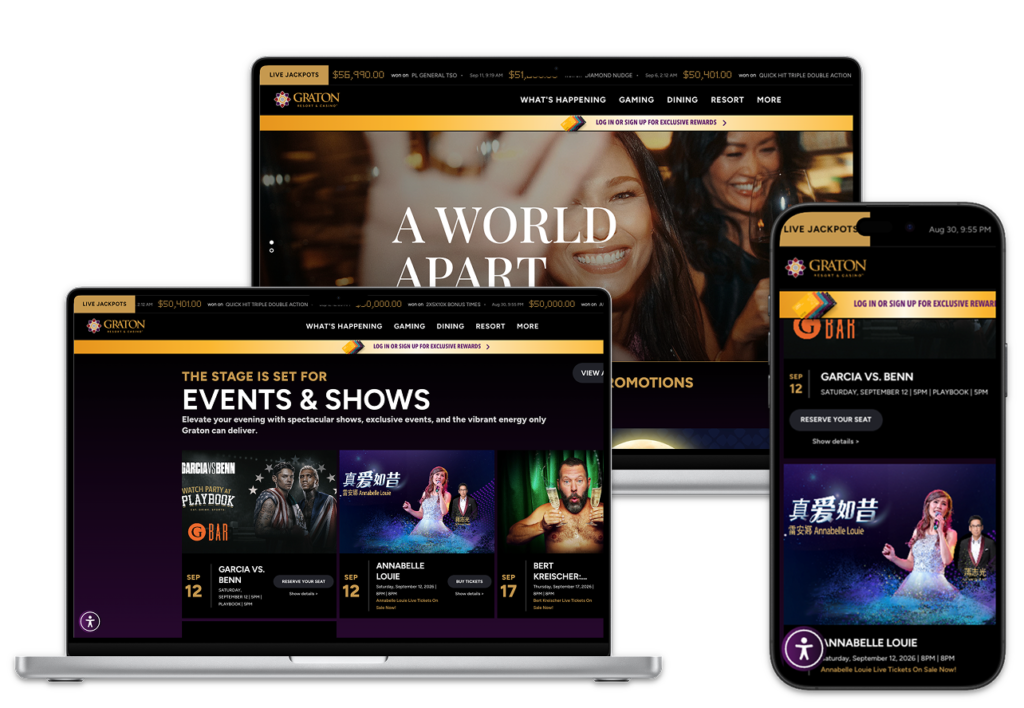
The new system needs to be designed around the people operating it and the experience it supports.
Before recommending a rebuild or migration, we look at the larger website ecosystem.
That includes:
How pages, services, locations, campaigns, products, and reusable content should be structured.
Who creates content, who reviews it, who publishes it, and where unnecessary developer dependencies exist.
Which layouts should be reusable, flexible, governed, or configurable by the content team.
What the website exchanges with CRM platforms, APIs, booking systems, payments, search, mobile applications, and other business systems.
Which URLs, metadata, internal links, content, structured data, and search visibility must be preserved.
Which tracking, conversion events, Search Console configurations, and marketing measurement need to survive the transition.
Where the current implementation is creating performance, reliability, deployment, or maintainability problems.
Who should be able to edit what, and how permissions and workflows should reflect the organization.
What the business may need to support next: new services, locations, brands, languages, applications, campaigns, or customer experiences.
The result is a modernization strategy based on the organization’s requirements rather than a predetermined technology stack.
We discuss your CMS, team, content, and dependencies to identify what needs investigation before recommending a platform.
We agree on the architecture and deliver the content system, integrations, migration, and training included in your scope.
Your editors gain a more consistent way to publish, while developers have a clearer foundation to maintain and extend.
Give marketing and content teams the ability to safely manage routine content without unnecessary developer dependency.
Reduce friction from idea → review → approval → publish.
Create clearer architecture, reusable components, documented workflows, and more predictable future development.
Protect valuable URLs, metadata, internal links, search visibility, and indexing during migration.
Improve the technical foundation where the existing platform is limiting speed or stability.
Give the right users the right permissions and create workflows that reflect how the organization actually operates.
Support future websites, applications, locations, languages, campaigns, or digital channels without immediately rebuilding the entire platform again.
Train the team and document the system so the organization is not permanently dependent on the implementation partner.

Clean up years of technical debt, improve editing workflows, rebuild templates, reduce unnecessary plugin dependency, and modernize the frontend without replacing the CMS when replacement is not needed.
Move content into a structured CMS while rebuilding the frontend around Next.js or another modern framework.
Move away from proprietary or difficult-to-maintain systems into an editor-friendly platform with broader internal ownership.
Replace aging platforms when custom frontend requirements, structured content, integrations, or multi-channel publishing justify a decoupled architecture.
Improve content models, workflows, integrations, preview tooling, frontend performance, or developer experience without unnecessarily replacing the CMS.

Headless architecture can be a strong fit when your organization needs:
Headless is not automatically the right choice for every organization. For many marketing websites, a well-architected WordPress implementation can remain simpler and more cost-effective.
We do not recommend a migration simply because a newer technology exists. The platform is selected around the business, content, team, workflows, and long-term requirements.
Every rebuild considers organic traffic, URL preservation, redirects, analytics, Search Console, conversion tracking, and performance from the beginning, not after launch.
Experience across WordPress, Next.js, React, TypeScript, headless CMS platforms, APIs, integrations, and cloud infrastructure allows us to recommend the architecture that best fits the project rather than forcing every project into the same stack.

No. Part of the discovery process is understanding how your team manages content, what integrations you rely on, how much content needs to be preserved, and what the platform needs to support long term. We can recommend whether it makes sense to stay on WordPress, move to another CMS, or use a headless architecture.
No. Headless is useful when the requirements justify it, such as structured content, multiple digital channels, complex integrations, or a highly custom frontend. For many marketing websites, a well-built WordPress setup can be simpler and more cost-effective to maintain.
We plan around important URLs, content, redirects, metadata, internal links, and indexing checks. No migration comes with a guarantee of unchanged rankings; the aim is to identify and manage risks before and after launch.
Yes. We can inventory the existing content, determine what should be kept, updated, consolidated, removed, or redirected, and map approved content into the new platform. The exact migration approach depends on the amount of content, how it is structured, and the capabilities of the current CMS.
Yes. These projects often involve close collaboration with marketing, communications, content, IT, or other internal stakeholders. We can design the CMS structure and publishing workflow around how your team actually works, while establishing clear review points and responsibilities throughout the project.
Yes. Training can be included for editors and administrators so your team understands how to create, update, review, and publish content in the new system. Depending on the engagement, this can also include recorded walkthroughs, written documentation, and role or permission guidance.
Yes. Post-launch support can include stabilization, troubleshooting, CMS support, performance monitoring, analytics validation, new components, integrations, and ongoing development. The exact support model is scoped based on how much technical ownership your team wants after launch.
For larger or more complex rebuilds, we may recommend a paid Platform Discovery & Architecture phase before estimating the full implementation. That gives us time to properly map the content, workflows, users, integrations, SEO requirements, technical risks, and target architecture so the rebuild can be scoped with much more confidence.
Yes. Editorial requirements should inform the system from the beginning. Training and documentation are defined in the scope so the team knows how to use the agreed workflows and components.
Tell us where publishing, maintenance, or integrations are slowing the team down.
During a 30-minute strategy call, we’ll discuss whether the right next step is an improvement, rebuild, migration, or deeper platform discovery.
BOOK A PLATFORM STRATEGY CALL
Usually responds within one business day.
