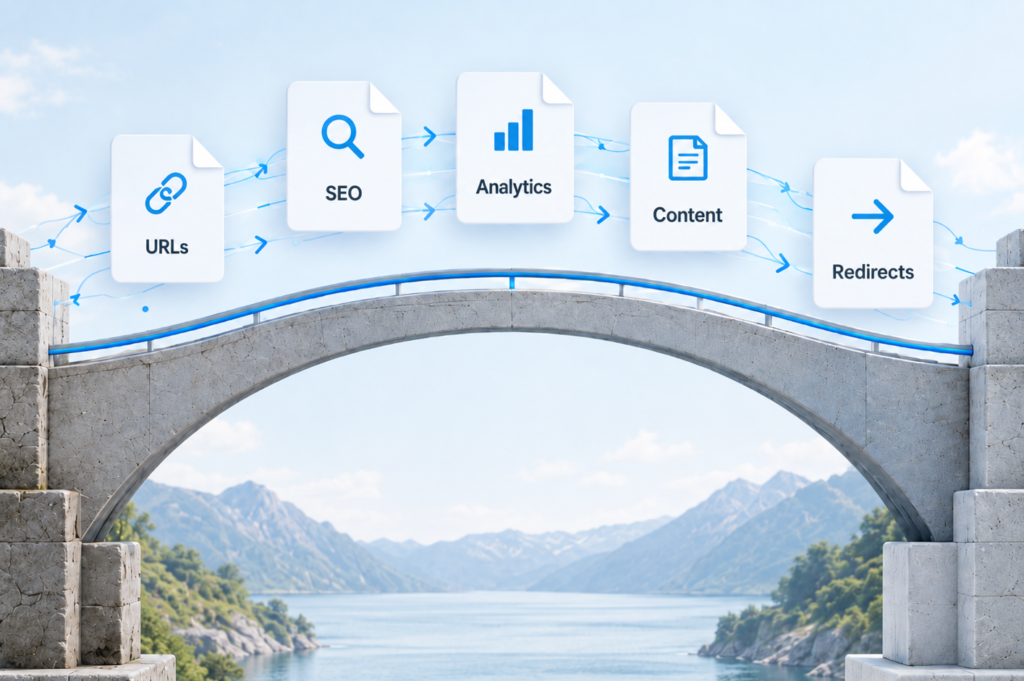
Migrating a website can solve a lot of problems.
A business may be moving from an outdated WordPress build to a modern site, replacing a legacy CMS, moving to a headless architecture, or bringing a website back in-house after relying on an outside vendor.
The new platform may be faster, easier to manage, and better suited for the business.
But there is also a real risk.
A poorly planned migration can damage years of work almost overnight.
Search rankings can disappear. Analytics can stop tracking correctly. Old URLs can break. Important metadata can get lost. Content can be missed during migration.
The goal should not simply be to launch a new website.
The goal should be to modernize the website while protecting the traffic, data, content, and search visibility the business has already earned.
What Can Go Wrong During a Website Migration?
Most migration problems do not come from the visual redesign itself.
They happen because important systems behind the website change at the same time.
A migration may affect:
- page URLs
- internal links
- metadata
- structured data
- analytics tracking
- conversion events
- images and media
- CMS content
- redirects
- page speed
- caching
- forms
- third-party integrations
- search engine indexing
If these pieces are not accounted for before launch, problems may not become obvious until traffic or conversions begin dropping.
1. Preserve Important URLs Whenever Possible
One of the safest things you can do during a migration is preserve existing URLs.
If a page currently ranks at:
/services/kitchen-remodeling/
there usually needs to be a strong reason to change that URL during the migration.
Changing URLs unnecessarily creates additional risk because search engines must understand that the old page moved somewhere else.
If URLs do need to change, every important old URL should be mapped to its most relevant new destination using a permanent redirect.
A migration plan should include a URL inventory showing:
Old URL → New URL → Redirect Required
Avoid simply redirecting every removed page to the homepage.
The destination should make sense for the visitor and for search engines.
2. Build a Redirect Map Before Launch
Redirects should not be something the team figures out after the new site is live.
They should be part of the migration plan.
Before launch, crawl or export the existing website and identify:
- pages receiving organic traffic
- pages with backlinks
- service pages
- landing pages
- blog posts
- campaign URLs
- important PDFs or resources
Each URL should either remain available or have a defined destination.
This is particularly important when moving between platforms such as:
- WordPress to Next.js
- Drupal to WordPress
- a custom CMS to a headless CMS
- an old WordPress theme to a rebuilt WordPress website
The frontend may change completely, but visitors and search engines still expect the old URLs to work.
3. Preserve SEO Metadata
A new website can look better while quietly losing important SEO information.
During migration, verify that important pages retain or intentionally update:
- page titles
- meta descriptions
- canonical URLs
- headings
- image alt text
- structured data
- Open Graph metadata
- index/noindex directives
This information may previously have been stored inside a plugin, CMS field, database table, or custom template.
Changing the technology stack means those fields often need to be deliberately mapped into the new system.
They do not automatically follow the content.
4. Protect Your Analytics
Analytics is another area where migrations frequently create problems.
The new site launches and appears to work correctly, but several weeks later someone notices:
- form submissions are missing
- Google Ads conversions dropped
- events are firing twice
- ecommerce revenue is incomplete
- booking conversions stopped
- custom dimensions disappeared
Analytics should therefore be treated as part of the migration itself.
Before launch, document the current tracking setup.
That may include:
- GA4
- Google Tag Manager
- Google Ads conversions
- Meta Pixel
- custom dataLayer events
- form tracking
- ecommerce events
- Calendly or booking events
- call tracking
- CRM attribution
Then verify the same measurement requirements on the new site.
A redesign that improves the website but breaks measurement leaves the business with less visibility than it had before.
5. Audit the Content Before Moving It
Website migrations are also a good opportunity to decide what should actually move.
Not every page needs to survive forever.
Before migrating content, classify it into categories such as:
Keep
Important pages that should move largely unchanged.
Improve
Pages that still matter but need better content, structure, or positioning.
Merge
Several weak pages that should become one stronger resource.
Remove
Outdated or unnecessary content that no longer provides value.
Removing content should still be handled carefully.
If the page receives traffic or has external links, it may need an appropriate redirect rather than simply disappearing.
6. Preserve Internal Linking
Internal links help visitors navigate the site, but they also help search engines understand the relationship between pages.
When URLs change, old internal links can remain buried inside:
- blog posts
- page content
- menus
- reusable components
- CMS fields
- footer links
A migration should include an internal-link review so the new website points directly to new URLs instead of relying on redirects everywhere.
7. Plan the CMS Structure Before Migrating Content
Moving the same content into a new CMS without reconsidering its structure can reproduce the same problems on a newer platform.
A migration is an opportunity to improve how content is managed.
Instead of hard-coding every page, a business may benefit from reusable content structures for:
- services
- locations
- team members
- events
- promotions
- case studies
- FAQs
- landing pages
The goal is not simply to give editors access to a CMS.
The goal is to create a system that allows the people responsible for the website to manage it safely without depending on a developer for every routine change.
8. Think About Performance Before Launch
A new technology stack does not automatically make a website fast.
Performance still depends on decisions involving:
- image delivery
- caching
- API requests
- server rendering
- third-party scripts
- hosting
- database queries
- CDN configuration
- frontend JavaScript
Performance requirements should be considered while the new site is being built rather than after launch.
For websites with different types of content, the caching strategy may also vary.
A mostly static service page may be cached aggressively, while frequently updated promotions, events, or authenticated areas may require a different approach.
9. Test the Migration Before Changing DNS
The first time the team sees the completed website should not be when it becomes publicly available.
Before launch, test the new environment for:
- broken links
- redirects
- forms
- analytics
- mobile usability
- page titles
- metadata
- canonical tags
- robots directives
- sitemap generation
- page speed
- API integrations
- important conversion paths
A staging environment gives the team a chance to find problems while the existing website is still available.
10. Monitor the Website After Launch
Launching the new site is not the end of the migration.
The first days and weeks after launch should include monitoring for unexpected issues.
Watch:
- organic traffic
- indexed pages
- 404 errors
- redirects
- conversion volume
- analytics events
- page speed
- server errors
- form submissions
Some migration issues only appear once real users and search engines begin interacting with the new site.
Early monitoring makes those problems easier to correct before they become larger losses.
Website Migration Checklist
Before launching a migrated website, confirm that you have:
- inventoried important existing URLs
- mapped old URLs to new URLs
- created required redirects
- preserved important metadata
- migrated important content
- reviewed internal links
- recreated analytics and conversion tracking
- verified forms and integrations
- configured canonical URLs
- checked robots.txt and indexing rules
- generated the correct XML sitemap
- tested mobile layouts
- reviewed site performance
- tested the staging environment
- created a post-launch monitoring plan
A Website Migration Is More Than a Redesign
The most successful migrations treat the existing website as an asset rather than something to throw away.
Your current website may contain years of accumulated value:
- search rankings
- backlinks
- content
- analytics data
- customer journeys
- integrations
- conversion tracking
A migration should preserve that value while improving the systems around it.
At Solorio Designs, we approach website migrations as both a development project and a risk-management project.
That means thinking about the CMS, frontend architecture, SEO, analytics, redirects, performance, and content structure together rather than treating each one as a separate afterthought.
If you’re planning a website migration or redesign, [Request a Strategy Call] to identify the technical and marketing risks before the migration begins.